Until We Could: From Page to Performance

I was deeply moved by this choral composition of my poem “Until We Could,” by composer Oliver Caplan. Thank you, Oliver, and the New Hampshire Master Chorale, for this beautiful song—an affirmation, an act of humanity, beauty, and resistance. I’m grateful for all the love and care that went into this, and for the tender words he shares below in reflection on the song’s evolution.

Recorded Live by the New Hampshire Master Chorale
Dan Perkins, Music Director
November 22, 2025

“Richard Blanco, President Barack Obama’s inaugural poet, wrote Until We Could in 2014 for the Freedom to Marry coalition. He frames the poem with a tender letter to his husband, Mark, and within those intimate bookends, he places their personal story in the wider arc of the marriage equality movement. At its heart, this is what sustains all social movements: real people, real lives.

I was first drawn to set Until We Could to music in honor of the tenth anniversary of Obergefell v. Hodges, the landmark Supreme Court decision that affirmed the nationwide right of same-sex couples to marry. That milestone is deeply personal for me as well—it came just three weeks after my own wedding, to my husband, Chris.

What began as a celebratory project has taken on a more sober tone in light of today’s climate. We are witnessing a painful rollback of gay rights—and civil rights more broadly. National Park sites, including Stonewall, have been ordered to censor their educational materials, erasing the “T” from LGBTQ+. Businesses have secured the right to refuse service to same-sex couples. Many states, including New Hampshire—where this piece is being premiered—have banned gender-affirming care for minors.

Now, more than ever, we must redouble our efforts for freedom and equality. We must retell history so that it is not forgotten, and we must carry forward the simplest and most enduring truth: Love is love.”

UNTIL WE COULD
for Mark

I knew it then—when we first found our eyes,
in our eyes, and everything around us—even
the din and smoke of the city—disappeared,
leaving us alone as if we were the only two
men in the world, two mirrors face-to-face:
my reflection in yours, yours in mine, infinite.

I knew since I knew you—but we couldn’t.

I caught the sunlight pining through the shears,
traveling millions of dark miles simply to graze
your skin as I did that first dawn I studied you
sleeping beside me: I counted your eyelashes,
read your dreams like butterflies flitting under
your eyelids and ready to flutter into the room.
Yes, I praised you like a majestic creature god
forgot to create, till that morning of you tamed
in my arms, first for me to see, name you mine.
Yes, to the rise and fall of your body, your every
exhale and inhale a breath I breathed as my own
wanting to keep even the air between us as one.

Yes to all of you. Yes I knew, but still we couldn’t.

I taught you how to dance Salsa by looking
into my Caribbean eyes. You learned to speak
in my tongue, while teaching me how to catch
a snowflake in my palms, love the grey clouds
of your worn-out hometown. Our years began
collecting in glossy photos time-lining our lives
across shelves and walls glancing back at us:
Us embracing in some sunset, more captivated
by each other than the sky brushed plum-rose.
Us claiming some mountain that didn’t matter
as much our climbing it, together. Us leaning
against columns of ruins as ancient as our love
was new, or leaning into our dreams at a table
flickering candlelight in our full-mooned eyes.

I knew me as much as us, and yet we couldn’t.

Though I forgave your blue eyes turning green
each time you lied, kept believing you, though
we managed to say good morning after muted
nights in the same bed, though every door slam
told me to hold on by letting us go, and saying
you’re right became as true as saying I’m right,
till there was nothing a long walk couldn’t solve:
holding hands and hope under the streetlights
lustering like a string of pearls guiding us home,
or a stroll along the beach with our dog, the sea
washed out by our smiles, our laughter roaring
louder than the waves. Though we understood
our love was the same as our parents, though
we dared to tell them so, and they understood.

Though we knew, we couldn’t—no one could.

When fiery kick lines and fires were set for us
by our founding mother-fathers at Stonewall,
we first spoke of defiance. When we paraded
glitter, leather, and rainbows, our word then
became pride down city streets, demanding:
Just let us be. But that wasn’t enough. Parades
became rallies—bold words on signs, shouting
until we all claimed freedom as another word
for marriage and said: Let us in, insisted: love
is love, proclaimed it into all eyes that would
listen at any door that would open, until noes
and maybes turned into yeses, town by town,
city by city, state by state, understanding us
and all those who dared to say enough until
the gavel struck into law what we always knew:

Love is the right to say: I do and I do and I do. . .

and I do want us to see every tulip we’ve planted
come up spring after spring, a hundred more years
of dinners cooked over a shared glass of wine, and
a thousand more movies in bed. I do until our eyes
become voices speaking without speaking, until
like a cloud meshed into a cloud, there’s no more
you, me—our names useless. I do want you to be
the last face I see—your breath my last breath,

I do, I do and will and will for those who still can’t

vow it yet, but know love’s exact reason as much
as they know how a sail keeps the wind without
breaking, or how roots dig a way into the earth,
or how the stars open their eyes to the night, or
how a vine becomes one with the wall it loves, or
how, when I hold you, you are rain in my hands.

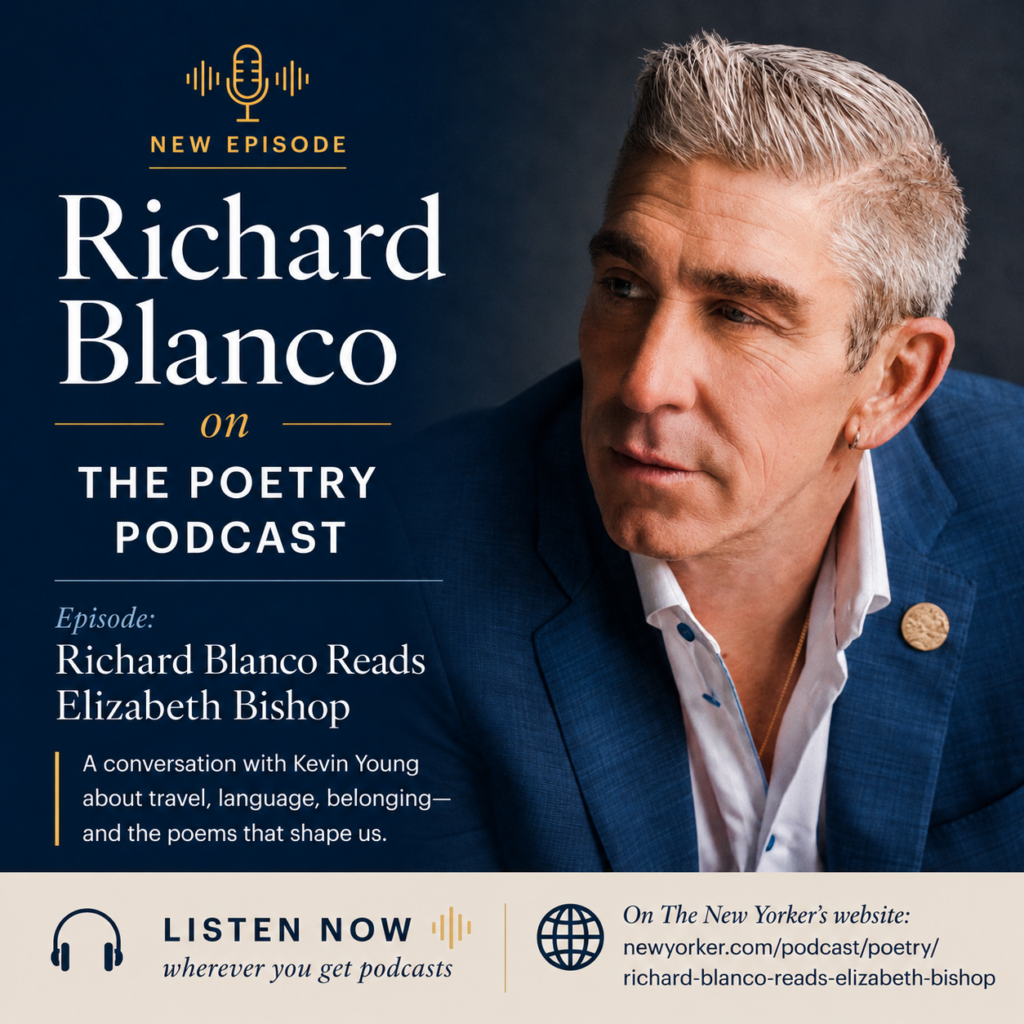
“The President’s Poet” on The Poet Speaks Podcast

“As poets, we ask questions that aren’t being asked. Art humanizes issues that are abstracted by the media… When I write a poem of witness, I see a face, a name, beyond the idea… I think this is the role of poetry in civic discourse. It’s quiet work, but there are a lot of us.” – Richard Blanco

Thank you to Amanda Eke of The Poet Speaks Podcast for the meaningful conversation about this poet’s journey and how poetry guides us toward better knowing ourselves and cultivating meaning in the world.

Explore podcasts on “The Poet Speaks,” HERE.

Inaugural Poet Richard Blanco Remembers Robert Frost & JFK


#FlashbackFriday to reflections on the power of poetry in civic discourse: Robert Frost’s “Stopping by Woods on a Snowy Evening,” and one of my favorite quotes by President John F. Kennedy:

“When power leads man toward arrogance, poetry reminds him of his limitations. When power narrows the area of man’s concern, poetry reminds him of the richness and diversity of his existence. When power corrupts, poetry cleanses.”

These ideas continue to inspire me today, just as they did when I wrote the inaugural poem, “One Today.”

*COMING SOON: *The Year of Writing with Richard Blanco,* kick-starts with “The Poetics of Protest” in January 2026. Keep an eye on my Workshops page for updates and registration details.

This video was produced by the JFK Library Foundation and the American Writers Museum.

“Waiting for Snow in Havana” – a musical in development.

A magical night with the creative team of “Waiting for Snow in Havana,” a musical in development that I am working on as co-lyricist. We shared demos of several songs, talked about the creative process, and next steps as we continue development. The musical is an adaptation of Carlos Eire’s memoir (by the same name) about his childhood in Cuba and separation from his parents through Operation Pedro Pan, a clandestine exodus of over 14,000 unaccompanied Cuban minors to the United States from 1960 to 1962. A tragic yet triumphant story about family, love, and the meaning of home.

Here’s the link to the demo song “Don’t Let Go,” sung by the main character, Carlos, to his 11-year-old self. In the song, he urges his younger self to hold on to his childhood innocence—soon to be lost when he must leave Cuba without his parents.

Reading at Longfellow House: “WE (too) THE PEOPLE”

Last week, I read poems on the lawn of the historic Longfellow House. I left with a renewed sense of hope for humanity — inspired by all who shared the space and placed their faith in words, in a shared vision of the America we know, and are still fighting to become.

 
To those who couldn’t be with us in person: I hope you’ll enjoy this recording of WE (too) THE PEOPLE on YouTube. Come sit with us. Let the poems find you — as prayers, as rituals of hope.
 
The WE (too) THE PEOPLE Reading Series is supported by the New England Poetry Club and the Defense of Democracy podcast. Special thanks to Arlington Poet Laureate Steven Ratiner for the invitation and for curating this timely, vital series.

Defense of Democracy Podcast – The Voice of a Poet: Richard Blanco

Thank you to Karen Svoboda for inviting me onto the Defense of Democracy podcast—and for holding space for such vital conversations. We spoke about poetry, democracy as a verb (not a noun), and the role of language in shaping who we are, both as individuals and as a nation.

In a time when so much feels uncertain, poetry has the power to remind us of our shared humanity and help us imagine a better, more just future. Poems may not change the world directly, but a poem can change a person who will change the world.

I hope you’ll take a listen, reflect, and share: defenseofdemocracy.org/podcast

“Uncertain – Sea Principle” A Poem for UNESCO’s Year of the Quantum Poetry Contest.


Grateful to share my poem, “Uncertain – Sea Principle” – a contrapuntal ode inspired by Werner Heisenberg—with UNESCO’s Quantum Year 2025 and the Brilliant (Quantum) Poetry Contest, open through June 30, 2025. This contest celebrates both the International Year of Quantum Science and Technology, and the centenary of quantum mechanics.

As an engineer-poet, I’ve always felt that quantum uncertainty echoes the human condition—our lives, like particles, pulse between knowing and becoming.

This contest invites poets and thinkers alike to give voice to the mysteries of quantum science through verse. Winners and runners-up will receive cash prizes, but more than that, the chance to explore science not as formula, but as a feeling.

Details: https://www.thebrilliantpoetry.com/

A Choral Composition by Oliver Caplan of “Cloud Anthem” by Richard Blanco

A belated note of gratitude to composer Oliver Caplan for his choral composition of my poem “CLOUD ANTHEM,” and to the New Hampshire Master Chorale with Juventas New Music Ensemble for their dulcet tones. This performance, recorded live on October 29th, 2022, at the Granoff Music Center in Medford, MA, is a moment to pause, breathe, and remember that we are always connected; we “hold light in our lucid bodies like blood…” read more…

María Magdalena Campos-Pons: “Procession of Angels for Radical Love and Unity”

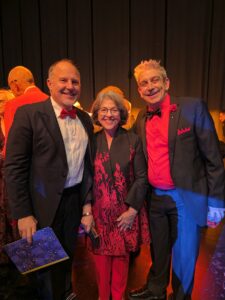
Last month, I was honored to unite with all who attended the “Procession of Angels for Radical Love and Unity”; neighbors, poets, historians, musicians, puppeteers, et al who walked the 2.5 miles through the streets of East Harlem, a.k.a. El Barrio in solidarity for a more compassionate future. Thank you to María Magdalena Campos-Pons and all involved in organizing this heart-touching event; for inviting me to read “Declaration of Interdependence”

Here are some photos of the day we all came together.

read more…

Categories

Archives