
Richard Blanco
Illuminating Poetry for Everyone
“An engineer, poet, Cuban American… his poetry bridges cultures and languages – a mosaic of our past, our present, and our future – reflecting a nation that is hectic, colorful, and still becoming.”
– President Joe Biden, conferring the National Humanities Medal on Richard Blanco
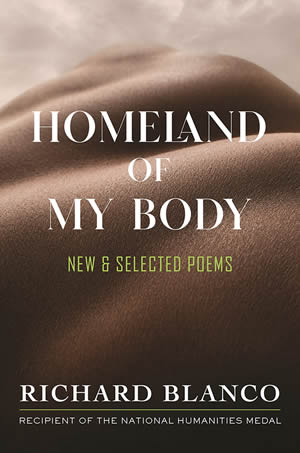
Homeland Of My Body: New & Selected Poems
Beacon Press, Release date: October 24, 2023.
A rich, accomplished, intensely intimate collection with two full sections of new poems bookending Blanco’s selections from his five previous volumes.
In this collection of over 100 poems, Richard Blanco has carefully selected poems from his previous books that represent his evolution as a writer grappling with his identity, working to find and define “home,” and bookended them with new poems that address those issues from a fresh, more mature perspective, allowing him to approach surrendering the pain and urgency of his past explorations. Pausing at this pivotal moment in mid-career, Blanco reexamines his life-long quest to find his proverbial home and all that it encompasses: love, family, identity and ultimately art itself. In the closing section of the volume, he has come to understand and internalize the idea that “home” is not one place, not one thing, and lives both inside him and inside his art.
Upcoming Events
October 1, 2026
Richard Blanco, Poet-Engineer Poetry & Nonfiction Reading & Book Signing.
West Lafayette, IN
More Info>>
October 3, 2026
Florida State Poets Association
Sanford, F.L.
More info>>
October 24 & Nov 1, 2026
Craft Tutorial: What Makes a Poem Memorable?
Virtual.
More info>>
Latest News
Nothing Here I Don’t Remember: A New Sonic Life for “Looking for The Gulf Motel”
Official Release Day!
When Michael Teichberg first shared the vision for Poetronica Records what resonated was the belief that poetry can reach new audiences while honoring the integrity of the written word.
Then I heard the first track inspired by my poem, “Looking for The Gulf Motel,” and I was deeply moved. My eyes still grow misty when I hear the song, particularly the Spanish version, and watch the music video. The spirit of the poem is untouched. While every word wasn’t carried over exactly as it appears on the page, the story is the same, as is the emotional truth. The ideas expressed in the poem have found a new sonic life. That’s when I knew I wanted to help shape what this new medium could become.
I’m grateful to join Poetronica as its founding artist,and I’m excited to see where this journey leads.If this medium helps even one more person discover the power of poetry, then it’s a journey worth taking. Every generation inherits the art forms of the one before it. Every so often, it discovers a new one.
If you’re a fellow poet who feels called to explore where poetry might go next, I hope you’ll join us. Poetronica is just beginning, and every new artistic movement is shaped by the people willing to take its first steps. Applications for our inaugural roster are now open. Email: founder@poetronicarecords.com
🎧 Listen to “Nothing Here I Don’t Remember” on Spotify, SoundCloud, and find all the links for listening at https://poetronicarecords.com/richard-blanco.
Richard Blanco Reading & Book Signing at Purdue University
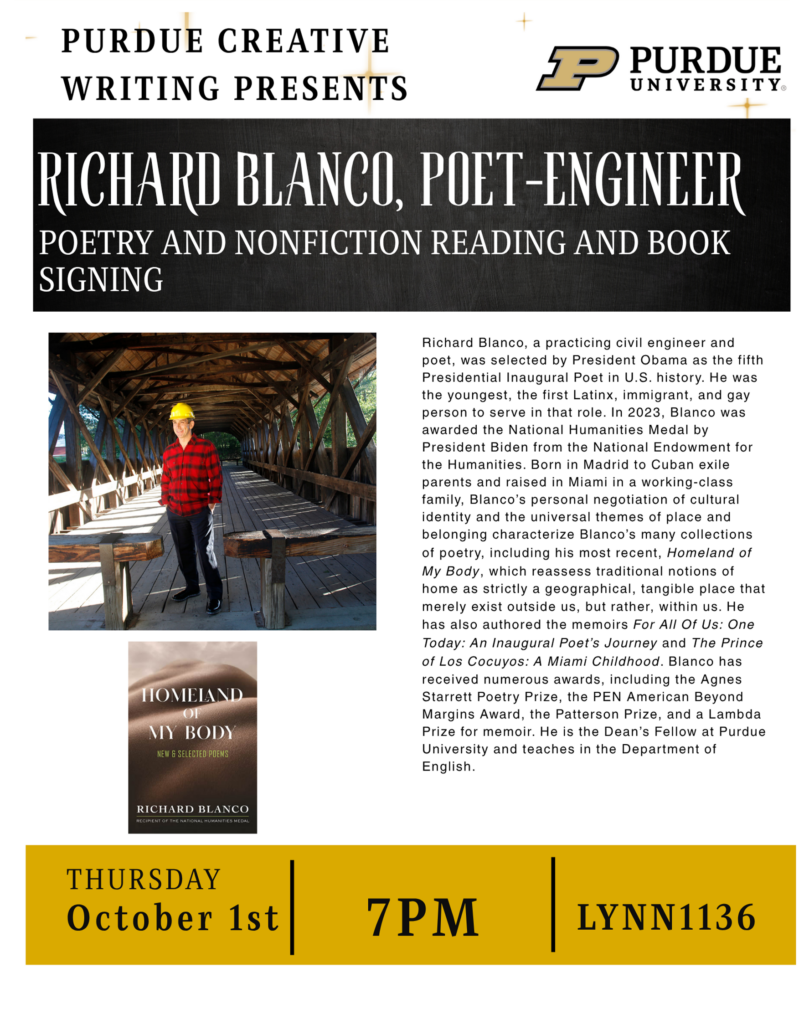
I’m delighted to share that my poetic debut as a poet-engineer at Purdue University is coming up!
On Thursday, October 1 at 7 p.m., I’ll give a poetry and nonfiction reading and book signing as part of the Visiting Writers Series, sharing selections from Homeland of My Body and other works that reflect on the intersections of poetry, engineering, place, identity, and belonging—ideas that have shaped my work throughout my life.
Copies of Homeland of My Body and other publications will be available for purchase and signing immediately following the reading.
Richard Blanco Reads Elizabeth Bishop
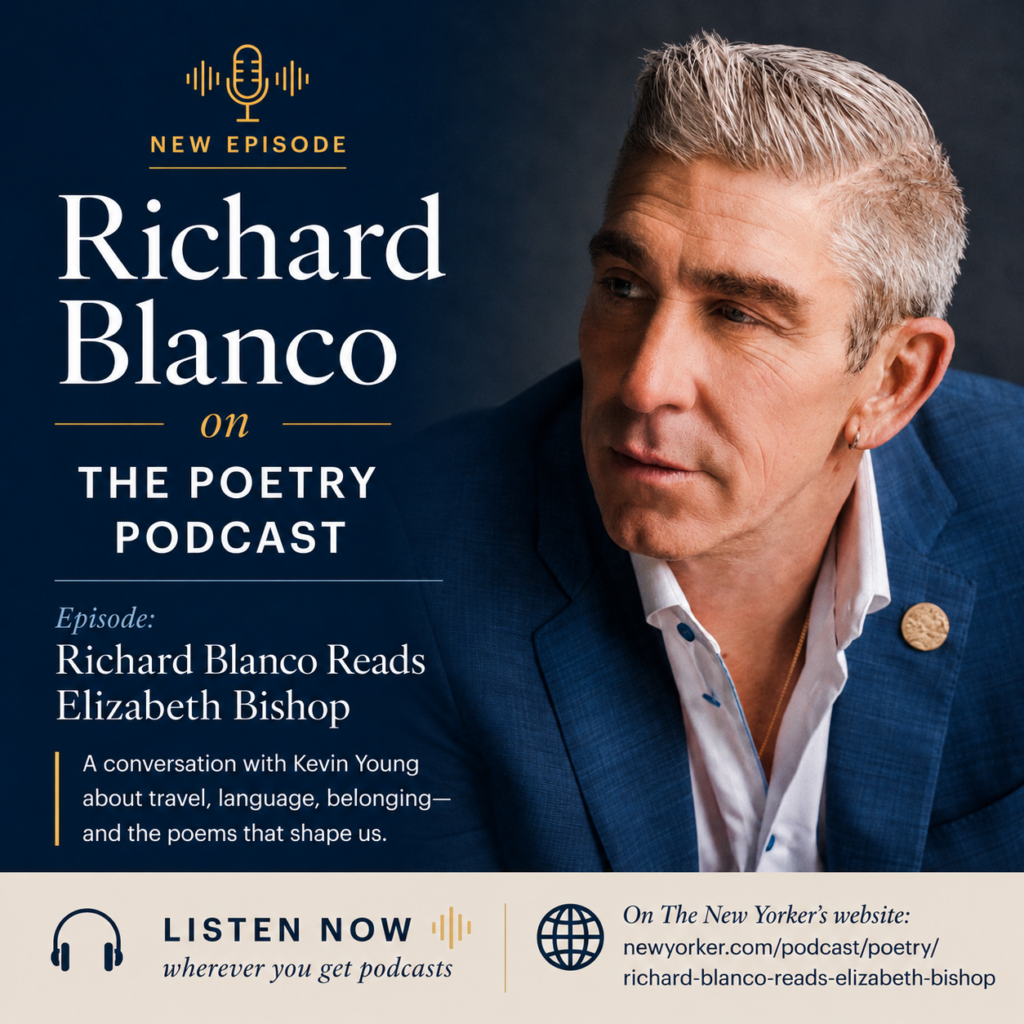
Few poets have stayed with me as long—or as deeply—as Elizabeth Bishop.
You can imagine my excitement to join Kevin Young on The New Yorker Podcast to read and reflect on Bishop’s poem, “Questions of Travel.”
Inspired by the years she spent living in Brazil, the poem speaks to one of the central questions that shapes my own work: What is home? How do we belong—to the landscapes we inhabit, the language we inherit, and one another? Our conversation explores the ways travel and language shape us—and how translation, in all its forms, becomes a way of understanding ourselves and each other.
I also had the chance to read my poem “My Father in English”—first published in The New Yorker—and to talk about how it came to me almost in a single breath. I remember translating for my parents when I was just five years old. Language became power, but it also became a way of fathoming love, sacrifice, and inheritance.
Thank you to Kevin for creating such a generous space for conversation, and for his enduring devotion to poetry and the meaningful questions it invites us to ask.
You can listen on The New Yorker’s website or wherever you get your podcasts.

All website content © Copyright 2026 Richard Blanco – Poet & Author | Privacy Policy